NachrichtenBearbeiten
https://odysee.com/@ovalmedia:d/mwgfd-impf-symposium:9
https://totalityofevidence.com/dr-david-martin/
| | Kaum beachtet von der Weltöffentlichkeit, bahnt sich der erste internationale Strafprozess gegen die Verantwortlichen und Strippenzieher der Corona‑P(l)andemie an. Denn beim Internationalem Strafgerichtshof (IStGH) in Den Haag wurde im Namen des britischen Volkes eine Klage wegen „Verbrechen gegen die Menschlichkeit“ gegen hochrangige und namhafte Eliten eingebracht. Corona-Impfung: Anklage vor Internationalem Strafgerichtshof wegen Verbrechen gegen die Menschlichkeit! – UPDATE |
Libera Nos A Malo (Deliver us from evil)
Transition NewsBearbeiten
Feed Titel: Homepage - Transition News Pilotverfahren gegen Einseitigkeit in den öffentlich-rechtlichen Medien: Leuchtturm ARD zieht vor die nächste Instanz
Die Bürgerinitiative Leuchtturm ARD setzt ihren juristischen Kampf für mehr Perspektivenvielfalt im öffentlich-rechtlichen Rundfunk fort. Nachdem (…)
WHO, Epstein-Spuren und Corona-Aufarbeitung: Die Spur führt tief in globale Macht- und Finanznetzwerke
In einem Gespräch mit dem österreichischen Sender AUF1 haben die Ärztin Maria Hubmer-Mogg, die Rechtswissenschaftlerin Beate S. Pfeil und (…)
Neuer Plan: Trump will eingefrorenes iranisches Vermögen anzapfen
 Milliarden russischer Gelder liegen im Westen eingefroren – und bleiben weitgehend unangetastet. Bei den iranischen Vermögen will Trump kurzen Prozess machen. Irans Außenminister reagiert scharf. Beschlossen und beschwichtigt: Der neue Abrechnungsdeckel könnte jeden Patienten treffen
Über den Tarifdeckel-Entscheid wurde von den großen Schweizer Leitmedien nicht sehr ausführlich berichtet. Dabei betrifft er praktisch jeden (…)
Betreutes Überweisen: Ihre Bank entscheidet jetzt, wem Sie Geld schicken dürfen
 Fünf-Euro-Überweisung an einen Journalisten – und die Bank schickt eine Embargo-Meldung. Kein Einzelfall: GLS Bank, Volksbank. Wer auf der internen „Sanktionsliste" steht, bekommt kein Geld mehr. Wer solche Banken hat braucht keine Stasi mehr. | Peter MayerBearbeiten
Feed Titel: tkp.at – Der Blog für Science & Politik Kernstücke der neuen WHO Verträge bringen Verlust der nationalen Souveränität der Mitgliedsstaaten
 Bekanntlich sollen bis Ende Mai Änderungen der Internationalen Gesundheitsvorschriften (IGV) beschlossen werden, die der WHO eine massive Ausweitung ihrer völkerrechtlich verbindlichen Vollmachten bringen sollen. […] Hardware-Schwachstelle in Apples M-Chips ermöglicht Verschlüsselung zu knacken
 Apple-Computer unterscheiden sich seit langem von Windows-PCs dadurch, dass sie schwieriger zu hacken sind. Das ist ein Grund, warum einige sicherheitsbewusste Computer- und Smartphone-Nutzer […] 25 Jahre weniger Lebenserwartung für "vollständig" Geimpfte
 Eine beunruhigende Studie hat ergeben, dass Menschen, die mit mRNA-Injektionen „vollständig“ gegen Covid geimpft wurden, mit einem Verlust von bis zu 25 Jahren ihrer […] Ostermärsche und Warnungen vor dem Frieden
 Ostern ist auch die Zeit der pazifistischen und antimilitaristischen Ostermärsche. Grund genug, um davor zu warnen. Tod nach Covid-Spritze: Ärzte im Visier der Justiz
 In Italien stehen fünf Ärzte nach dem Tod einer jungen Frau aufgrund der „Impfung“ vor einer Anklage. |
NZZBearbeiten
Feed Titel: Wissenschaft - News und Hintergründe zu Wissen & Forschung | NZZ
Helium: Was das flüchtige Edelgas so besonders macht – und warum Fachleute jetzt nach Afrika schauen
PODCAST «NZZ QUANTENSPRUNG» - Giotto: Eine Schweizer Firma verspricht KI-Unabhängigkeit für Europa
INTERVIEW - Medizinethiker über Leihmutterschaft: «Natürlich ist das Kind in einer prekären Situation»
INTERVIEW - «Bei uns verschwinden die Gletscher wohl», sagt der bekannteste Gletscherforscher der Schweiz
DIE NEUESTEN ENTWICKLUNGEN - Toter Buckelwal: Bizarre Spekulationen nach mysteriösem Laborbericht
VerfassungsblogBearbeiten
Feed Titel: Verfassungsblog
Found Writing
This editorial is part of our “Behind the Scenes” series, in which our editors and authors describe their creative process in the age of artificial intelligence. How do ideas come to us? How do we sow and water them, and how do we know when they are ripe? And what role does artificial intelligence play in all of this?
In one of his tracks, the rapper Vega writes: I’m disappearing for a year, because I only write when it hurts. One could read that therapeutically, yet nothing in it speaks of writing as release, let alone redemption. The sting sits deeper: it sits in writing itself. To write is to fail – rarely in one’s own words, mostly in those of others.
Almost everything comes from outside. The idea for this editorial no less than all the other problems I am confronted with or pose myself. To write about creativity – perhaps even my own – in the age of “AI” therefore struck me as hardly worthwhile. It will already be written down somewhere, or at the very least is being written right now. I simply haven’t read it yet. And that is what this shall be about: a writing that reads – a “found writing.”
This term, too, came from outside. A few days ago, electrified, as so often, by the topic I had been handed, I was strolling through a major city of the Upper Palatinate and felt myself transported, just as often, into intellectually thin air. Like everyone in our line of business, I had of course given some thought to the breakneck development of “AI,” but those thoughts had stayed in my head, shaped by the outside world only through rather abstract observations. With sterile notions of that sort I could not – and one cannot, in the emphatic sense – write anything. Real, object-bound thinking requires text: someone else’s text.
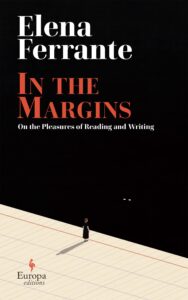 None of this was on my mind. A little later, for entirely different reasons, I found myself in a bookshop, letting the shelves drift past me in the familiar twilight of intentionality. Then, suddenly, the arc closed. I had a topic, and the bookshop had a book. It was Elena Ferrante’s singular essay collection In the Margins (Europa Editions). Its astonishing cover shows a small Rückenfigur, apparently female, standing at the red margin line of a sheet of graph paper and staring into the darkness beyond, faced by nothing but two white dots. Eyes, presumably. I reached for it.
That paper is the field on which a human being’s linguistic creative power plays out. The darkness behind it is whatever does not come from one’s own text but from outside. The object to the subject – or, if you will: that painful “adversary instance”1) called reality. It hurts not only because it both offends and impels us but also because, as scholars, we can and must run up against it with language. In form, the two belong together, and only together do they make possible the “leap” from private thought onto the public page: “Writing is therefore a cage, and we enter it at once, with our very first line” – coupled with the insight “that every form is a cage, not very stable and yet necessary, if one wants to strive to write as no one has written before” (emphasis VL).
++++++++++Advertisement++++++++++++
 Die Universität Kassel, Fachgebiet Öffentliches Recht, IT-Recht und Umweltrecht (Prof. Dr. Gerrit Hornung), sucht zum 1.10.2026:
Wissenschaftliche:r Mitarbeiter:in (m/w/d), EG 13 TV-H, befristet (für 3 Jahre), 75% (Aufstockung auf bis zu 100% möglich)
zur Bearbeitung eines DFG-Projekts zu Rechtsfragen von Desinformation auf Online-Plattformen
Bewerbungsfrist: 11.08.2026; weitere Informationen im Ausschreibungstext.
++++++++++++++++++++++++++++++++
It is this recalcitrance, one that has gone by many names, with which any textual scholarship must first come to terms. There must be reading and digesting – a great deal of reading, a great deal of digesting, and, if anything, even more forgetting – lest some “clever dilettantism,” which “tends hastily to plunder a text or two” (Maria Corti), fabricate texts that are either eerily slick or shoddily glued together. That is laborious, certainly; on the other hand, it cuts against the imperatives of an academic system that rewards the CV-padding production of schematic, fashionable, glossy – in a word: undialectical set pieces, which founder neither on given forms nor on preceding objects, which in fact no longer fail at anything at all – and only through ultimately failing would have something to say.
“AI” practises precisely this “clever dilettantism.” It knows nothing of the impulses and resistances of an “out there,” because it is not itself, as a (bodily) subject, in the “out there.” It is text. The limits of “its” language are not the limits of “its” world. Though such limits might, for a human, still be transcended, they do not apply here: the “AI” has no world distinct from its mathematized language model. It is caught in absolute identity with itself – caught, however, precisely not in such a way that linguistic form could ever become a “cage” for it, and hence not in such a way that it could notice, in Ferrante’s sense, “that not a single word is truly ours.” Our words are nothing foreign to “AI”; rather, it “exists” only in the very act of their shameless appropriation. Beyond the red line on the page there is, for it, nothing but more page.
For this editorial, by contrast, that “age-old principle” holds: no human text gets by without a pre-text. Endless material could be drawn from elsewhere and from Ferrante’s lectures, composed shortly before the epoch of “AI.” Here, a plea for the practice of writing shall suffice. For write we must, even if frustration at the claustrophobic deficiency of means, end, and man may govern its daily round. Only in a writing practice that knows its own defects and yet walks straight into their midst can we, “while we toil and sweat, also discover another possible path” (emphasis added, all my translation).
That is the tragedy – ours and ours alone – of writerly creativity, and at the same time the source of that “full feeling” of the passion of putting to paper, “once and perhaps never again,” something capable of breaking out, for a moment, of the cage of found writing, necessary though that cage is; for fifty pages perhaps, perhaps for five, perhaps only for a single paragraph. To man, and to man alone, no science can be worth anything that (s)he cannot pursue with this passion.
++++++++++Advertisement++++++++++++

Eurojusitalia invites early-career scholars to submit papers for its latest call, focusing on the national follow-up to rulings by the Court of Justice of the European Union and the General Court. This initiative examines the critical phase after a judgment, where EU law is implemented and its real-world impact is tested within domestic legal systems. Interested researchers must submit an abstract by September 30, 2026, for this study on European legal integration.
You can find the Call for Papers here.
++++++++++++++++++++++++++++++++
The artist Vega did what is often not at our disposal. He could withdraw for a year when no resistances or impulses arrived from “out there.” We, by contrast, must write if we want to stay on top – or at least stay in the game. That “AI” should strike some quarters as so shattering follows, quite consistently, from the “iron cage” of an organization of scholarship for which the mechanical churning out of text and its yardsticks of success had become the norm long before large language models. Even inside this cage, individual spaces of freedom can be carved out; but to regard them as given to us in the same way as our linguistic constitution would be to mistake the social for an existentiale. Of tragedy, then, there can be no question: scholarly creativity exists only on the terms set by its own conditions.2)
*
Editor’s Pick
by MAXIM BÖNNEMANN
Copyright: Nomos Verlag
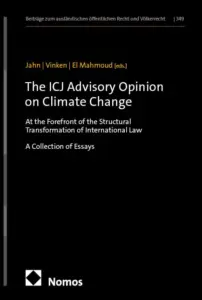
We recently launched our new Law and Climate Spotlight. Elsewhere, too, scholars are experimenting with new, open formats in international climate law. I’ve been working through this book, which grew out of Völkerrechtsblog’s excellent blog symposium on the International Court of Justice’s climate advisory opinion. From the tension between sovereignty and community interest, to the interplay of public and private power, to the role of epistemic uncertainty and postcolonial asymmetries, the book situates the ICJ opinion within a larger structural transformation of international order. In a few days, the climate opinion turns one. Anyone wanting to understand how it has already shaped so much of national and international climate policy in so short a time should have this book close at hand.
*
The Week on Verfassungsblog
summarised by EVA MARIA BREDLER
We researchers and scribblers dream of being able to disappear for a year because we only write when it hurts (Venga, above). Politicians, by contrast, seem to be fighting their disappearance with every means of art (and of law) at their disposal (because they only rule when it hurts?).
So, Marine Le Pen announced her candidacy hours after a court upheld her criminal conviction. GIOVANNI CAPOCCIA (ENG) shows why Le Pen has placed one of Europe’s oldest democracies on a collision course between electoral politics and judicial authority. Last week, CHARLOTTE SCHMITT-LEONARDY viewed the judgment as though Lady Justice had briefly lifted her blindfold – the piece is now also available in English.
The European Parliament was asked to lift the blindfold as well: the European Public Prosecutor’s Office requested that the Parliament waive the immunity of two MEPs, but the Parliament refused. NIKLAS SIMON (GER) explains why the relationship between the two institutions is increasingly reaching a breaking point.
By contrast, the European Parliament showed more courage concerning the questionable parties. On 7 July 2026, it voted by a broad majority to review whether the Europe of Sovereign Nations Party should be struck off the register of European political parties. The decision was triggered by the Authority for European Political Parties and European Political Foundations – an independent body without an equivalent in German party-ban proceedings. EVA ISABELL MARTIN (GER) argues that German party-ban proceedings could benefit from a supplementary trigger mechanism modelled on the European example. LEONARD HOFFMANN (GER) analyses the body behind it: an agency that doesn’t fit the usual scheme, and in which administration and politics blur.
As it is well known, law and politics blur regularly in the EU. On 29 June 2026, the European Parliament’s Constitutional Affairs rapporteur, Charlie Weimers, published a draft report on the interplay between the CJEU and national courts, criticising their delicately balanced relationship. ALBERTO ALEMANNO (ENG) summarises the proposals and defends the current model – while acknowledging that the Court also bear some responsibility to improve this relationship.
In the meantime, the European Commission acknowledged Meta’s responsibility: it preliminarily found Meta in breach of the Digital Services Act for the “addictive design” of Instagram and Facebook. In view of its arguably shaky legal basis, JULIAN MORGAN (ENG) above all highlights the decision’s strategic and symbolic dimensions.
AI, as we know, can produce biased outputs – partly because it is trained using unrepresentative data. But can more encompassing data fix that? Taking the example of people with disabilities, PHILIPPA DUELL-PIENING (ENG) explains why the push for representative data creates human rights risks – especially regarding autonomy – with little proven benefit.
The Indian Supreme Court dealt with autonomy in a much more tangible way. In Prajwala, it held that victims of sex trafficking have a right to rehabilitation. PRANAV MITTAL (ENG) considers the judgment a missed opportunity to protect the rights of sex workers. He argues that the concept of decisional autonomy could do the trick.
One of the biggest threats to our autonomy is the climate crisis. Which is why we at Verfassungsblog as of now devote a Spotlight section to it. Its most recent face was Europe’s June heatwave, which killed thousands. Yet rights-based climate litigation involving adaptation in Europe has until recently been notably absent. PARUL KUMAR and CHRIS HILSON (ENG) explain why – and how this should change.
++++++++++Advertisement++++++++++++
International climate law has never mattered more. That’s why Verfassungsblog has built a growing body of work on climate law and governance, cited widely within and beyond academia. Our new Law and Climate Spotlight brings this work together in one place.
If you value independent, rigorous commentary on climate law and governance, please consider supporting us.
++++++++++++++++++++++++++++++++
Australia is a country highly vulnerable to the impacts of climate change. It is also one of the largest global exporters of fossil fuels, coal and gas. This contradiction plays out in Australia’s domestic climate policy and is at the heart of a new complaint to the UN Human Rights Committee, labelled the “Hard Truths” case. JACQUELINE PEEL (ENG) explains the complaint and sketches possible outcomes.
Volkswagen had to face its own hard truths in Brazil: 50 years after enslaving workers in the Amazon, VW was again convicted – a year after being ordered to pay a record $32 million in moral damages. SAULO DE MATOS and HEITOR GUIMARÃES (ENG) explain the differences between the rulings and why the 2026 rulings may open a new era of corporate reckoning.
A constitutional reckoning, meanwhile, is unfolding in Hungary: on Monday, the Hungarian Parliament adopted a new constitutional amendment effectively removing the President of the Republic from office. NÓRA CHRONOWSKI (ENG) contextualises this extraordinary measure – and explains why she considers it justified.
While Hungary is going through a consequential change in power, Scottish voters returned the Scottish National Party to power for the fifth successive time. CATRIONA MULLAY (ENG) explains that beneath the stasis, there is more taking place than meets the eye.
By contrast, many in Germany might wish for a bit of stasis themselves: in September, Saxony-Anhalt, Mecklenburg-Western Pomerania and Berlin will elect new state parliaments. Government formation is likely to be complicated, and each Land handles it differently: rigid deadline here, flexibility there. LORENZ MÜLLER, SVEN T. SIEFKEN and PHILIPP CARTIER (GER) show: faster is not necessarily better.
Given current polling numbers, anti-constitutional ministers could soon be found not only in Saxony-Anhalt and Mecklenburg-Western Pomerania, but also in the next federal government. A defence minister from the AfD ranks, for example. What options would the soldiers actually have when their commanding minister would no longer stand on the ground of the free democratic basic order? At present, soldiers would have no legal way to quit service on that basis. Since a desertion even in this case arguably remains a criminal offence, MUSTAFA ENES ÖZCAN (GER) calls for a legal exit option.
We too will soon be stepping back from duty: next week, we will publish our last newsletter before the summer break. But we won’t be stepping back entirely, of course, and certainly not for a whole year, as rapper Venga longs for. “For write we must” – as Victor Loxen writes in this week’s editorial.
*
That’s it for this week. Take care and all the best!
Yours,
the Verfassungsblog Team
If you would like to receive the weekly editorial as an e-mail, you can subscribe here.
References
| ↑1 | Hans Blumenberg, Realität und Realismus, p. 111 (my translation). |
|---|---|
| ↑2 | As the Federal Constitutional Court, too, was well aware: BVerfGE 35, 79 (120 ff.), holding that the organization of university self-governance must itself accommodate the constitutionally guaranteed freedom of research and teaching. |
The post Found Writing appeared first on Verfassungsblog.